Corroboree
This week I was inspired by a gathering at a Perth mosque to remember the victims massacred at the two mosques in Christchurch on March 15.
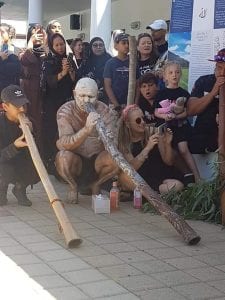
It was a co-performance of ‘Corroboree for Life’ and ‘Haka for Life’ – Corroboree For Life came to being in April 2018 with the objective of lowering the suicide rates in Aboriginal and Torres Strait Islander communities. This program empowers Aboriginal people to proudly celebrate their culture and build their self-identity and worth. Together with former New Zealander, Maori man Leon Ruri, Noongar man Ash Penfold called for members of the Aboriginal community to come together to create the Corroboree for Life and the Haka for Life programs.
What was presented at the Perth mosque was a merging of Australian and New Zealand first nations peoples through their cultural performances. It celebrated cultural diversity and harnessed an ancient cultural authority to re-centre societal views. The event called on the broader community to be more accepting and tolerant. I thank all involved for this inspiring message.
But what can this mean for a music teacher and music education?
We will examine the background of the concept ‘Corroboree’ and how this could be used in the classroom.

What Is A Corroboree?
The word ‘corroboree’ has been, and is a generic term to describe First Nations cultural performances of sound, music and dance.
Nyungar man and Associate Professor from Edith Cowan University, Clint Bracknell provided more detail regarding the meaning and origin of the word ‘corroboree’. Clint is the Vice Chancellor’s Research and Teaching Fellow of Indigenous Australia Education Research at the Mount Lawley, Perth based campus. Clint has previously worked as Senior Lecturer at the Sydney Conservatorium of Music.
He says of a corroboree…
When talking about Nyungar vocal music, some performers use the word ‘corroboree’ to refer to a public performance of Aboriginal song and dance. This term is considered to be the anglicised version of a word meaning ‘dance’ in Dharug, an Aboriginal language from Western Sydney, New South Wales (Stubington 2007: 228) and as such should be considered part of a cross-cultural vocabulary, rather than a traditional Nyungar word. It is also in the Oxford and Merriam-Webster dictionaries so is an English word.
https://en.oxforddictionaries.com/definition/corroboree
https://www.merriam-webster.com/dictionary/corroboree
Stubington, Jill. 2007. Singing the Land: The Power of Performance in Aboriginal Life. Strawberry Hills: Currency House Inc.
Is Corroboree An Appropriate Term To Use?
While it is in common use it is probably not an appropriate term to use. The term created by English colonists to generically describe of traditional Aboriginal performances. A more appropriate term would be “traditional performance” or to use the local language word. Noongar Elder, and singer songwriter George Walley, tells me the word his mob uses for dance is ‘middar’. You may enquire of your local community or research what word First Nations peoples would use.
Can Non Indigenous People Participate In A Traditional Performance?
Some Australian First Nations performances are formal and only certain people are permitted to participate in them in specified roles. If you are at an Aboriginal performance it would be appropriate to wait until you are invited to participate.
Can We As Music Teachers Teach Traditional Performance?
As a non-Indigenous Australian, without cultural authority, I wouldn’t. ‘Corroboree’ is a term used to describe Aboriginal traditional performances. It should be led by Aboriginal people.
Can We Facilitate Traditional Performance Elements Respectfully?
It is ideal to have Aboriginal people lead such activities and performances. There are many incursion groups and Aboriginal dancers available across the country who can come to and work within schools. Payment for them imparting cultural knowledge and expertise is appropriate.
Another option is to utilise Aboriginal people from within your local community (staff, school families, students) to lead students in performing. These volunteers may feel comfortable leading the whole activity or with providing additional information or support when an online or video resource. Seek out support well in advance to the activities.
As previously mentioned an option is to utilise a video or online resource as the main form of instruction. The teacher should step back and work as a facilitator. This is the least ideal option in terms of appropriate transmission of cultural knowledge. A way of making it more acceptable is by asking a parent of an Aboriginal student at your school, if you have any, to preview the resource with you or to run your lesson ideas by them for their feedback. Be open to doing things differently if engaging in such discussions.
Activities
Early Childhood To Middle Primary
Teaching Concept – Tempo
The following link contains some great videos of traditional performances that are appropriate for students to join in with. It is taken from the ‘One Child’ website. ‘One Child’ is a business that services early learning centres to assist with documentation. The videos are from the traditional lands now found across Australia and the Torres Strait. Please make it clear to the students that these performances are location specific and it is appropriate to acknowledge the country and the language group being represented where possible.
https://one-child.com/727/aboriginal-animal-dance/ Queensland, Northern Territory, Torres Strait Islands and New South Wales
Discuss with students the tempo of the rhythms used particularly with the tapping sticks which indicate different animal movements. Create a class or group composition of animal activities with matching tempo terms.
Upper Primary to Lower Secondary
Teaching Concept – Responding To Music Appropriately
Watch a traditional dance performance such as https://www.youtube.com/watch?v=0LW4Vxvw9hU Gija People, East Kimberly Western Australia
Give the accompanying explanatory information attached to the video to provide cultural context to the performance. Discuss.
Watch two Move It Mob Style videos. Replay each several times. Have students learn the dances.
‘Move It Mob-Style’, an Australian dance-based youth, health and fitness TV show that showcases young Aboriginal and Torres Strait Islander people’s culture through dance and music.
Students to perform in small groups their own ‘corroboree’ using the contemporary moves inspired by the Move It Mob Style videos to the more traditional style music.
Appropriate instrumental music could include tracks from itunes from the following :
The Heart Of Australia – David Hudson and Friends
The Art Of Didjeridoo – William Barton, Sydney Symphony Orchestra and Richard Gill
Lightning Man – Matthew Doyle
Musique Sacrees – Tradition Aborigene Didjeridoo Australien ‘The Frog’ Richard Walley
Upper Secondary and Choral and Instrumental
Teaching Concept – Arrangement
Have students watch one of the videos from the link supplied. https://one-child.com/727/aboriginal-animal-dance/ Queensland, Northern Territory, Torres Strait Islands and New South Wales
As a class or in small groups graphically notate the different instruments – tapping sticks, vocal line, didjeridoo line.
Use the graphic notation to produce a different arrangement of a part of a song from the choir or instrumentalists repertoire.

Corroboree For Life Concept
A fantastic activity for Harmony Day would be for different cultures to come together and produce a shared community performance similar to the ‘Corroboree’ and ‘Haka for Life’ models where the groups perform separately and then together.
I see this idea of ‘Corroboree for Life’ and ‘Haka for Life’, not as a model for what we should be doing in schools, but rather a presentation of what could be done for future Harmony Day ceremonies. Children of different backgrounds being absorbed and involved in cultural performances, separately and then together.
‘Haka for Life’ founder Leon Ruri reflected on the ANZAC performance in Kings Park in 2018 that “The spirit within the cultures coming together has been the most spectacular thing to me.” “Its so important that we bring two cultures together. Two are stronger than one. It’s an opportunity to display our cultures and together, powerfully”.
The cultural fusion created by the ‘Corroboree for Life’ and ‘Haka for Life’ programs has been inspiring. Look to your own communities and see what you can perpetuate culturally and musically. Peace.