Corroboree

Corroboree

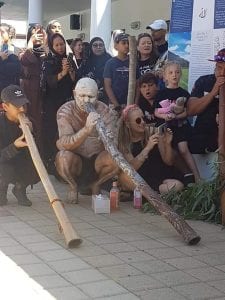
This week I was inspired by a gathering at a Perth mosque to remember the victims massacred at the two mosques in Christchurch on March 15.

It was a co-performance of ‘Corroboree for Life’ and ‘Haka for Life’ – Corroboree For Life came to being in April 2018 with the objective of lowering the suicide rates in Aboriginal and Torres Strait Islander communities. This program empowers Aboriginal people to proudly celebrate their culture and build their self-identity and worth.  Together with former New Zealander, Maori man Leon Ruri, Noongar man Ash Penfold called for members of the Aboriginal community to come together to create the Corroboree for Life and the Haka for Life programs.

What was presented at the Perth mosque was a merging of Australian and New Zealand first nations peoples through their cultural performances. It celebrated cultural diversity and harnessed an ancient cultural authority to re-centre societal views. The event called on the broader community to be more accepting and tolerant.  I thank all involved for this inspiring message.

But what can this mean for a music teacher and music education?

We will examine the background of the concept ‘Corroboree’ and how this could be used in the classroom.

What Is A Corroboree?

The word ‘corroboree’ has been, and is a generic term to describe First Nations cultural performances of sound, music and dance.

Nyungar man and Associate Professor from Edith Cowan University, Clint Bracknell provided more detail regarding the meaning and origin of the word ‘corroboree’.  Clint is the Vice Chancellor’s Research and Teaching Fellow of Indigenous Australia Education Research at the Mount Lawley, Perth based campus.  Clint has previously worked as Senior Lecturer at the Sydney Conservatorium of Music.

He says of a corroboree…

When talking about Nyungar vocal music, some performers use the word ‘corroboree’ to refer to a public performance of Aboriginal song and dance.  This term is considered to be the anglicised version of a word meaning ‘dance’ in Dharug, an Aboriginal language from Western Sydney, New South Wales (Stubington 2007: 228) and as such should be considered part of a cross-cultural vocabulary, rather than a traditional Nyungar word. It is also in the Oxford and Merriam-Webster dictionaries so is an English word.

https://en.oxforddictionaries.com/definition/corroboree

https://www.merriam-webster.com/dictionary/corroboree


Stubington, Jill. 2007. Singing the Land: The Power of Performance in Aboriginal Life. Strawberry Hills: Currency House Inc.


Is Corroboree An Appropriate Term To Use?

While it is in common use it is probably not an appropriate term to use. The term created by English colonists to generically describe of traditional Aboriginal performances. A more appropriate term would be “traditional performance” or to use the local language word. Noongar Elder, and singer songwriter George Walley, tells me the word his mob uses for dance is ‘middar’. You may enquire of your local community or research what word First Nations peoples would use.


Can Non Indigenous People Participate In A Traditional Performance?

Some Australian First Nations performances are formal and only certain people are permitted to participate in them in specified roles.  If you are at an Aboriginal performance it would be appropriate to wait until you are invited to participate.


Can We As Music Teachers Teach Traditional Performance?

As a non-Indigenous Australian, without cultural authority, I wouldn’t.  ‘Corroboree’ is a term used to describe Aboriginal traditional performances.  It should be led by Aboriginal people.


Can We Facilitate Traditional Performance Elements Respectfully?

It is ideal to have Aboriginal people lead such activities and performances.  There are many incursion groups and Aboriginal dancers available across the country who can come to and work within schools. Payment for them imparting cultural knowledge and expertise is appropriate.

Another option is to utilise Aboriginal people from within your local community (staff, school families, students) to lead students in performing.  These volunteers may feel comfortable leading the whole activity or with providing additional information or support when an online or video resource.  Seek out support well in advance to the activities.

As previously mentioned an option is to utilise a video or online resource as the main form of instruction.  The teacher should step back and work as a facilitator.  This is the least ideal option in terms of appropriate transmission of cultural knowledge.  A way of making it more acceptable is by asking a parent of an Aboriginal student at your school, if you have any, to preview the resource with you or to run your lesson ideas by them for their feedback.  Be open to doing things differently if engaging in such discussions.


Activities

Early Childhood To Middle Primary

Teaching Concept – Tempo

The following link contains some great videos of traditional performances that are appropriate for students to join in with.  It is taken from the ‘One Child’ website.  ‘One Child’ is a business that services early learning centres to assist with documentation. The videos are from the traditional lands now found across Australia and the Torres Strait. Please make it clear to the students that these performances are location specific and it is appropriate to acknowledge the country and the language group being represented where possible.

https://one-child.com/727/aboriginal-animal-dance/ Queensland, Northern Territory, Torres Strait Islands and New South Wales

Discuss with students the tempo of the rhythms used particularly with the tapping sticks which indicate different animal movements.  Create a class or group composition of animal activities with matching tempo terms.


Upper Primary to Lower Secondary

Teaching Concept – Responding To Music Appropriately

Watch a traditional dance performance such as https://www.youtube.com/watch?v=0LW4Vxvw9hU Gija People, East Kimberly Western Australia

Give the accompanying explanatory information attached to the video to provide cultural context to the performance. Discuss.

Watch two Move It Mob Style videos.  Replay each several times.  Have students learn the dances.

‘Move It Mob-Style’, an Australian dance-based youth, health and fitness TV show that showcases young Aboriginal and Torres Strait Islander people’s culture through dance and music.

Students to perform in small groups their own ‘corroboree’ using the contemporary moves inspired by the Move It Mob Style videos to the more traditional style music.

Appropriate instrumental music could include tracks from itunes from the following :

The Heart Of Australia – David Hudson and Friends

The Art Of Didjeridoo – William Barton, Sydney Symphony Orchestra and Richard Gill

Lightning Man – Matthew Doyle

Musique Sacrees – Tradition Aborigene Didjeridoo Australien ‘The Frog’ Richard Walley


Upper Secondary and Choral and Instrumental

Teaching Concept – Arrangement

Have students watch one of the videos from the link supplied.  https://one-child.com/727/aboriginal-animal-dance/ Queensland, Northern Territory, Torres Strait Islands and New South Wales


As a class or in small groups graphically notate the different instruments – tapping sticks, vocal line, didjeridoo line.

Use the graphic notation to produce a different arrangement of a part of a song from the choir or instrumentalists repertoire.


Corroboree For Life Concept

A fantastic activity for Harmony Day would be for different cultures to come together and produce a shared community performance similar to the ‘Corroboree’ and ‘Haka for Life’ models where the groups perform separately and then together.


I see this idea of ‘Corroboree for Life’ and ‘Haka for Life’, not as a model for what we should be doing in schools, but rather a presentation of what could be done for future Harmony Day ceremonies.  Children of different backgrounds being absorbed and involved in cultural performances, separately and then together.


‘Haka for Life’ founder Leon Ruri reflected on the ANZAC performance in Kings Park in 2018 that “The spirit within the cultures coming together has been the most spectacular thing to me.” “Its so important that we bring two cultures together. Two are stronger than one. It’s an opportunity to display our cultures and together, powerfully”.

The cultural fusion created by the ‘Corroboree for Life’ and ‘Haka for Life’ programs has been inspiring.  Look to your own communities and see what you can perpetuate culturally and musically.  Peace.

Acknowledging Country

Acknowledging Country


For important events in Australia it is now common, and best, practice to start with a ‘Welcome To Country’ or ‘Acknowledgement of Country’.

Below is some information published by ‘Reconciliation Australia’ about the difference between the two ‘welcomes’, when they should be used and by whom.

I have been pondering for a while about possible musical applications of the’ Acknowledgement of Country’, when, thank you universe, a beautiful and simple song is composed and shared by my friend Jemma King.

Jemma, like myself, is not Aboriginal but sings with the choir Madjitil Moorna.  This is a choir in Perth, Western Australia, led by Aboriginal musicians and singer songwriters.  It is all about the sharing and promotion of cultural understandings and preservation of local languages while being in a safe environment.

Jemma wrote this lovely song with the guidance and endorsement by Noongar Elder Marie Taylor, Noongar language custodian, Marinda Hansen, and Bibbulmum singer songwriter Della Rae Morrison.

This song is not a replacement for an ‘Acknowledgement to Country’.  Rather it is a musical additional which could enhance the ceremony.

The song would be particularly appropriate after an ‘Acknowledgement’ for primary schools to perform at assemblies and formal events.  It would also be appropriate for musical performances in any school.

This song can be used in any Aboriginal country in Australia.  All that needs to change is the name of the Aboriginal or Torres Strait Islander country that the land is being performed on. It is important to check this and get it right.

Acknowledging Country

©Jemma King 2018 with guidance from Marie Taylor, Merinda Hansen and Della Rae Morrison

Before singing, please clarify with the traditional custodians, the name of the country you are upon, and change lyrics accordingly.

We acknowledge the land on which we now stand

Has always been ___________ country

We pay our respect to elders past

Those present and those of the future


We acknowledge the land on which we now stand

Has always been ___________ country

We pay our respect to elders past

Those present and those of the future


For thousands and thousands of years

First Nations peoples have cared for our country

We pay our respect to the oldest continuous

living culture in the world


We acknowledge the land on which we now stand

Has always been __________ country

We pay our respect to elders past

Those present and those of the future


We acknowledge the land on which we now stand

Will always be ____________ country

Acknowledging Country

©Jemma King 2018 with guidance Marie Taylor, Merinda Hansen and Della Rae Morrison

Before singing, please clarify with the traditional custodians, the name of the country you are upon, and change lyrics accordingly.

Acknowledgement Song Resources

Below are some resources to go with the song. These have been provided through the generosity of Jemma King.  When using these resources please ensure her work as the composer and the support of the Noongar community is shared with the audience, as we would for any other piece of work we are performing.  Below Jemma has also permitted the sharing of mp3 files of the song and the chords.

Acknowledgement Song For Whadjuk Country

Acknowledgement Song For Unspecified Country


Here are the chords.

The Acknowledgment Song_Template_©Jemma King 2018 (4)-25iyqvt

I have used the lyrics of the song to create a welcome poster on the door of my music room combined with images of the ‘country’ near my school.  You might do this too?


Welcome to and Acknowledgement of Country

The following guidelines have been drawn from the website of ‘Reconciliation Australia’. Please check it out yourself and research any local protocols that may apply.

  1. What is a Welcome to Country?

Protocols for welcoming visitors to Country have been a part of Aboriginal and Torres Strait Islander cultures for thousands of years. Despite the absence of fences or visible borders, Aboriginal and Torres Strait Islander groups had clear boundaries separating their Country from that of other groups. Crossing into another group’s Country required a request for permission to enter. When permission was granted the hosting group would welcome the visitors, offering them safe passage and protection of their spiritual being during the journey. While visitors were provided with a safe passage, they also had to respect the protocols and rules of the land owner group while on their Country. Today, obviously much has changed, and these protocols have been adapted to contemporary circumstances. However, the essential elements of welcoming visitors and offering safe passage remain in place. A Welcome to Country occurs at the beginning of a formal event and can take many forms including singing, dancing, smoking ceremonies or a speech in traditional language or English. A Welcome to Country is delivered by Traditional Owners, or Aboriginal and Torres Strait Islander people who have been given permission from Traditional Owners, to welcome visitors to their Country.

  1. What is an Acknowledgment of Country?

An Acknowledgement of Country is an opportunity for anyone to show respect for Traditional Owners and the continuing connection of Aboriginal and Torres Strait Islander peoples to Country. It can be given by both non-Indigenous people and Aboriginal and Torres Strait Islander people. There are no set protocols or wording for an Acknowledgement of Country, though often a statement may take the following forms. General: I’d like to begin by acknowledging the Traditional Owners of the land on which we meet today. I would also like to pay my respects to Elders past and present. Specific: I’d like to begin by acknowledging the Traditional Owners of the land on which we meet today, the (people) of the (nation) and pay my respects to Elders past and present. Similar to a Welcome to Country, an Acknowledgement of Country is generally offered at the beginning of a meeting, speech or formal occasion.

  1. Why are Welcomes to Country and Acknowledgements of Country important?

Aboriginal and Torres Strait Islander peoples have experienced a long history of exclusion from Australian history books, the Australian flag, the Australian anthem and for many years, Australian democracy. This history of dispossession and colonisation lies at the heart of the disparity between Aboriginal and Torres Strait Islander and non-Indigenous Australians today. Including recognition of Aboriginal and Torres Strait Islander people in events, meetings and national symbols is one part of ending the exclusion that has been so damaging. Incorporating welcoming and acknowledgement protocols into official meetings and events recognises Aboriginal and Torres Strait Islander peoples as the First Australians and Traditional Custodians of land. It promotes an ongoing connection to place of Aboriginal and Torres Strait Islander Australians and shows respect for Traditional Owners. In Aboriginal and Torres Strait Islander cultures, the meaning of Country is more than just ownership or connection to land, as Professor Mick Dodson explains: “When we talk about traditional ‘Country’…we mean something beyond the dictionary definition of the word. For Aboriginal Australians…we might mean homeland, or tribal or clan area and we might mean more than just a place on the map. For us, Country is a word for all the values, places, resources, stories and cultural obligations associated with that area and its features. It describes the entirety of our ancestral domains. While they may all no longer necessarily be the title-holders to land, Aboriginal and Torres Strait Islander Australians are still connected to the Country of their ancestors and most consider themselves the custodians or caretakers of their land.”


References:

https://www.reconciliation.org.au/wp-content/uploads/2017/11/Welcome-to-and-Acknowledgement-of-Country.pdf

Jemma King – Acknowledgement Song mp3 files and lyrics documents, 2018.


Mission Songs Project : Songs Back Home SATB Choirbook

In a previous post ‘The Songs Back Home’ Choirbook and CD were recommended as one of the top three resources for embedding Indigenous cultures in Music education.


In preparing to present at a workshop for the Western Australian Orff Schulwerk Association it is this resource that I have again turned to.  Because of this I thought it timely to demonstrate in greater detail the value of the resource.


Jessie Lloyd – The Leader Of The Project

Originally from the tropics of North Queensland, Jessie Lloyd is an Aboriginal and Torres Strait Islander musician. Jessie first became curious about the songs form the Aboriginal reserves or the mission days when she heard her Aunties singing an old tune from Palm Island, Queensland called ‘The Irex’. The Irex was the name of a boat that was used to transport the stolen generation children and those removed under the Aborigines Protection Act in the early to mid-20th century.


This curiosity prompted two years of researching and reviving old mission songs through consultation with senior Indigenous songmen and songwomen. Jessie travelled Australia visiting various communities and elders seeking their stories and advice about the music and life of the old days. Her being the recipient of the State Library of Victoria – Creative Fellowship Award 2016 and the National Library of Australia – Folk Fellowship Award 2017, provided valuable access and resources into researching the oral history.

What Were Missions?

Aboriginal missions were created by churches or religious individuals to house Aboriginal people and train them in Christian ideals and to also prepare them for work. Most of the missions were developed on land granted by the government for this purpose. Around ten missions were established in NSW between 1824 and 1923, although missionaries also visited some managed stations. Many Aboriginal people have adopted the term ‘mission’ or ‘mish’ to refer to reserve settlements and fringe camps generally.

https://www.environment.nsw.gov.au/chresearch/ReserveStation.htm

What Were Reserves?

Aboriginal reserves were created as a political response to the dispossession of Aboriginal people from their land. … Aboriginal reserves:Aboriginal reserves were parcels of land set aside for Aboriginal people to live on; these were not managed by the government or its officials.

https://www.environment.nsw.gov.au/chresearch/ReserveStation.htm

What Happened To The Aboriginal Missions and Reserves?

In the 1920s and ’30s, and again in the 1950s and ’60s, large numbers of reserves were closed or reduced in size by the APB and Aborigines Welfare Board (which replaced the APB). The occupants were moved onto a smaller number of large reserves and the land from the closed reserves was often sold.


In the 1920s and ’30s reserves were closed so that Aboriginal communities could be concentrated in fewer reserves and Aboriginal people could be ‘managed’ more easily and affordably. Creating reserves that were closer to towns meant that people and businesses in those towns could access Aboriginal labour, while ensuring that Aboriginal people would continue to live outside of town. In the 1940s, ’50s and ’60s, under the Aborigines Welfare Board, the forced migration of Aboriginal people from unsupervised reserves onto stations closer to towns was part of the drive to assimilation, and was ultimately directed towards dispersing Aboriginal people into houses in country towns. At the same time it was about greater control over Aboriginal peoples’ lives.

Where possible, many Aboriginal people continued to live at sites after their reserve status had been revoked.

https://www.environment.nsw.gov.au/chresearch/ReserveStation.htm


What Is The ‘Mission Songs Project’

The objective of the project was the researching and reviving of the old mission songs.  The outcomes of that project so far have been four-fold.

Firstly, there have been a series of national and international performances where the songs and their stories, as well as the stories behind the project have been told.

Secondly a CD called ‘The Songs Back Home’ of recordings of ten tracks from the mission days. It is available as a CD and as downloads from Itunes. The CD comes with a fold out information sheet which gives the lyrics and chords.  This is really helpful for teachers who would like to create arrangements for different tuned percussion instruments, ukuleles, guitars or band instruments.

Thirdly a Choir Songbook has been published and available to purchase.  It contains background to each of the songs from the CD ‘The Songs Back Home’ as well as the standard music notation in four part, SATB for each.  This notation increases the value of the resource to classroom music teachers.  It enables teachers to easily adapt the material for lessons and to arrange for the particular instruments and skill level of students in individual education contexts.

The songs in the CD and the Songbook are so rich.  Aside from the four part harmony arrangements, which are too advanced for my primary school context, the background stories supporting the songs also convey important information about these pieces that our students need to hear. This supports a more comprehensive learning above the otherwise untold history of this country.

Fourthly, there are some Youtube clips that are useful resources.  One clip is of four singers on the road, rehearsing in the car on the way to the next performance.  This in itself is a great example of the working life of contemporary Australian musicians. Another clip is of Jessie making a family recipe of damper in her kitchen to the audio of the track ‘Down In The Kitchen’. Another is the deeply poignant ‘The Irex’ which scrolls through the lists of families and persons who were transported on the vessel to Palm Island, many never to return to the mainland.

The stories surrounding the songs are important, especially in this NAIDOC year of ‘Voice Treaty and Truth’.  These songs give voice to Aboriginal stories from the mission days and the era of the ‘stolen generations’.  They speak a truth that has been too unpalatable to be discussed in society at large.  It is time these truths are no longer hidden.  These songs will illuminate historical facts.


A review of ‘The Songs Back Home’ by Muriel Swijghuisen Reigersberg reports that Jessie Lloyd has hinted that Mission Songs Project has three or four albums yet to come.  Follow the Mission Songs Project website to watch for these developments.

‘The Songs Back Home’ CD and Choir Songbook are available from the Mission Songs Project website store and the CD tracks are available through download on Itunes. http://missionsongsproject.com/. This is also a the place to watch for performances of the Mission Songs Project as they occur around the country and the world.


Early Childhood to Year 2 Activities

Down In The Kitchen

  • Teach song.
  • Whilst rest of children singing the song, one child or an adult could role play cooking using toy food and kitchen equipment.
  • The others watch and guess what meal or snack they are preparing.
  • Repeat with different meals or snacks created by children.
  • Make ‘Jessie’s’ Coconut Damper – as per Youtube clip


Middle Primary to Lower Secondary Activities

The Irex’

  • Teach lead part of song.
  • In groups lyrics create a small spoken performance of the lyrics with ocean/sailing ship soundscape accompaniment. Play with rhythm, dynamics, tempo for dramatic effect.
  • Teach soprano part. Combine vocal sections.
  • Perform as a rondo with two part song as the A sections and group performances as the other sections.

Upper Primary to Lower Secondary

  • Notate soundscape or The Irex melody
  • View Mission Songs Project Youtube clip
  • Discuss how the presented imagery of the clip has changed perceptions or understandings of the song.  Compare the clip to other music video clips.


Vocal Activities

  • Pick a song from the songbook and perform in unison, two part, three part, four part or five.
  • Record and send to Mission Songs Project – they would love to see how their work is being interpreted – contact form is available on the website http://missionsongsproject.com/
  • Have students write a journal entry or series of entries about their feelings on performing the piece – written, visual or video


Instrumental Activities

  • Pick a song from the CD and transpose into a favoured key for your schools instruments. Have students learn and perform in unison, two part, three part, four part or five.
  • Record and send to Mission Songs Project – they would love to see how their work is being interpreted – contact form is available on the website http://missionsongsproject.com/
  • Have students write a journal entry or series of entries about their feelings on performing the piece – written, visual or video
  • Use one of the pieces as a warm up or sight reading activity


References:

http://musictrust.com.au/loudmouth/the-songs-back-home-the-mission-songs-project/   Review of the album by Muriel Swijghuisen Reigersberg

https://missionsongsproject.com/about/

https://www.environment.nsw.gov.au/nswcultureheritage/Missions.htm

Videos

The Irex and Removals List QLD 1922  https://www.youtube.com/watch?v=yBU9rTIH1B0

Down In The Kitchen and Making Coconut Damper  https://www.facebook.com/watch/?v=1534936106807517

Rehearsing Via Road-trip To Next Venue  https://www.facebook.com/watch/?v=1658213844479742


From Little Things Big Things Grow

‘From Little Things Big Things Grow’
Vincent Lingiari – Paul Kelly and Kev Carmody

WARNING: Visitors should be aware that this website includes images and names of deceased people that may cause sadness or distress to Aboriginal and Torres Strait Islander peoples.

This weekend is a Labour Day weekend holiday in Western Australia. With this in mind an important Australian musical story came to mind. A story that began with a labour dispute on a cattle station in the Northern Territory.

Over years the issue developed into one of land rights, sovereignty and the triumph of the small battler over the bully, privileged and rich. This story inspired a song born during a campfire at a camping trip taken by Paul Kelly and Kev Carmody.
The song has gone on to become an anthem and so important it has inspired many musicians to perform their own versions, artists to create works and museums to create exhibitions.
This is such a big song. It is the story it presents that is overwhelming important and long. The gentle way the music is used doesn’t cloud the messages of the story.
The song and its story is held together by repetition of the chorus. That chorus keeps us waiting. While we wait, we wonder how will this story end? Even though we know how it ends, its still triumph every time we hear it.
The Get Up Mob, a performers coordinated by the ‘Get Up’ advocacy group, reworked the song after the apology by Kevin Rudd to the Stolen Generations in 2008. It is an interesting take and interesting to compare to the original. Performers in the ‘Get Up Mob’ included Kev Carmody and Paul Kelly, Urthboy (Tim Levinson), Missy Higgins, Mia Dyson, Radical Son, Jane Tyrrell, Dan Sultan, Joel Wenitong and Ozi Batla. The video clip featured elements of the apology to the Stolen Generations, made by Prime Minister Kevin Rudd on 13 February 2008, as well as former Prime Minister Paul Keating’s Redfern Speech on 10 December 1992 John Butler, Leah Purcell, Pat Dodsonand Anthony Mundine.

Song Background
Kev Carmody and Paul Kelly were on a camping trip when they came up with the tune around the campfire. Kelly had the lilting chord progression, while Carmody had the idea of telling the little-heard story of the Gurindji strike: an event that seemed curious at the time, but was to blossom into the land rights movement.
Indigenous communities had provided a cheap – often free – source of labour for cattlemen in the Northern Territory since the 1800s. It was widely known that the Indigenous workers were forced to eke out an existence under squalid conditions, but for the most part the country turned a blind eye.
That changed at the Wave Hill cattle station in August 1966 when Vincent Lingiari announced that the Gurindji people – traditional owners of the land – were going on strike. The entire community walked off the station and at first it was assumed that this was a fight over working conditions. Eventually management offered them a pay rise, only to discover that the group weren’t striking for fairer treatment. They wanted their land back.
During this period Lingiari and fellow spokesman Billy Bunter Jampijinpatoured the eastern states. Public interest in the case took hold, and it fed into the enthusiasm for the 1967 constitutional alteration giving the federal government power to make laws concerning Indigenous Australians, which until that point had been a state responsibility.
The 1972 election of the Whitlam government brought land rights to the national political stage, and a portion of the Wave Hill land was returned to the Gurindji people in a ceremony between the PM and Lingiari on August 16, 1975 (“And through Vincent’s fingers poured a handful of sand”), with the Aboriginal Land Rights Act becoming law the following year.
Andrew P Street article from The Guardian
www.theguardian.com/music/australia-culture-blog/2014/feb/04/australian-anthems-paul-kelly-and-the-messengers-from-little-things-big-things-grow

Song Lyrics
From Little Things Big Things Grow
by Paul Kelly and Kev Carmody

Gather round people I’ll tell you a story
An eight year long story of power and pride
’Bout British Lord Vestey and Vincent Lingiarri
They were opposite men on opposite sides

Vestey was fat with money and muscle
Beef was his business, broad was his door
Vincent was lean and spoke very little
He had no bank balance, hard dirt was his floor

From little things big things grow

Gurindji were working for nothing but rations
Where once they had gathered the wealth of the land
Daily the oppression got tighter and tighter
Gurindji decided they must make a stand

They picked up their swags and started off walking
At Wattie Creek they sat themselves down
Now it don’t sound like much but it sure got tongues talking
Back at the homestead and then in the town

From little things big things grow

Vestey man said I’ll double your wages
Seven quid a week you’ll have in your hand
Vincent said uhuh we’re not talking about wages
We’re sitting right here till we get our land

Vestey man roared and Vestey man thundered
You don’t stand the chance of a cinder in snow
Vince said if we fall others are rising

From little things big things grow

Then Vincent Lingiarri boarded an aeroplane
Landed in Sydney, big city of lights
And daily he went round softly speaking his story
To all kinds of men from all walks of life

And Vincent sat down with big politicians
This affair they told him is a matter of state
Let us sort it out, your people are hungry
Vincent said no thanks, we know how to wait

From little things big things grow

Then Vincent Lingiarri returned in an aeroplane
Back to his country once more to sit down
And he told his people let the stars keep on turning
We have friends in the south, in the cities and towns

Eight years went by, eight long years of waiting
Till one day a tall stranger appeared in the land
And he came with lawyers and he came with great ceremony
And through Vincent’s fingers poured a handful of sand

From little things big things grow

That was the story of Vincent Lingiarri
But this is the story of something much more
How power and privilege can not move a people
Who know where they stand and stand in the law

From little things big things grow

Copyright: Paul Kelly and Kev Carmody www.nma.gov.au/learn/classroom-resources/from-little-things-big-things-grow

ACTIVITIES
K-2
• Explain the background to Vincent Lingiari and the Gurindji walk off as described above. Sing ‘From Little Things Big Things Grow’ to children.
• Have children join in with the chorus.
• Class discussion around the importance of the story and the role the song played in societal awareness.
• Play a couple of different versions and have the children respond to the song with illustrations.

2-6
• Complete the activities as in K-2
• Inspired by Zillmere State School video https://www.youtube.com/watch?v=FJxw2zgzLUs have students write and record their own class/school version of the song
• Explore ascending and descending skip and leaps in the chorus of the song. Students play the chorus, describe where the skips and leaps are occurring, then where ascending and descending.
• Discuss the role the triple meter plays. Try singing it (or playing) in duple.
• Rhythmic notation activity in correctly arranging the passages to match the chorus of ‘From Little Things Big Things Grow’. (A copy of this worksheet is below)

7-12
• Complete the activities as in K-2
• Discussion of Kelly and Carmody’s invocation of the medieval musical bard or minstrel telling stories in a time where musical storytelling was the news. Does this strategy work? Is it condescending? Why/not?
• Role of musical repetition – music does not detract from the story.
• Choose another Australian story that could be told in such a way. Write and perform two verses and a chorus. Some suggestions are below:
Ned Kelly – outlaw
Lawrence Hargraves – aviator
Charles Perkins – first Aboriginal politician
Edith Cowan – first female politician
Snowy River Scheme
Batavia
C Y O’Connor – WA Engineer who was credited with the worlds longest water pipeline between Perth and Kalgoorlie.

Vocal
• Allocate a verse for an individual student to work with an ensemble. The other members of the ensemble are responsible for their own verses.
• All to come together for the chorus.
• Determine harmonies for the chorus.
• Focus – strategies and skills on conveying to the audience that all working together as a musical group when singing and when not singing.

Instrumental
• Student to choose a verse to play. Focus is on expressing the intention and story of lyrics – focus on expression – light and shade – emphasis and fade out, ebb and flow, staccato and legato
or
• Own improvisation over the chord progression of the chorus for a new middle eight section
or
• Improvise with the melody of the chorus

Additional Background Information and References
Biography of Vincent Lingiari www.ia.anu.edu.au/biography/lingiari-vincent-14178
Classroom activities www.nma.gov.au/learn/classroom-resources/from-little-things-big-things-grow
Importance of the song www.nfsa.gov.au/latest/from-little-things-25-years
Inspiration of the song www.aso.gov.au/titles/music/from-little-things-big-things/notes/
Classroom activities www.narragunnawali.org.au
Get Up Mob reworking of the song
http://top40-charts.com/songs/lyrics.php?sid=23363&onlylyrics=1
www.revolvy.com/page/From-Little-Things-Big-Things-Grow
www.theguardian.com/music/australia-culture-blog/2014/feb/04/australian-anthems-paul-kelly-and-the-messengers-from-little-things-big-things-grow

Different Recordings and Performances
Paul Kelly Video Clip www.youtube.com/watch?v=6_ndC07C2qw
Kev Carmody and Mark Aitkins on didjeridoo www.youtube.com/watch?v=NqFXjk98l6w
John Butler, Missy Higgins and Dan Sultan www.youtube.com/watch?v=QbaQ6hI0Elk
Sarah Storer and Archie Roach www.youtube.com/watch?v=2hGeDj-V1c0
Get Up Mob Revision of song www.theloop.com.au/project/bangbang/portfolio/from-little-things-big-things-grow-by-the-getup-mob-music-video-large-collaborative-project/18879
Zillmere State School https://www.youtube.com/watch?v=FJxw2zgzLUs

Get Up Mob Lyrics
As Prime Minister of Australia, I am sorry.
On behalf of the Government of Australia, I am sorry.
On behalf of the Parliament of Australia, I am sorry.
And I offer you this apology without qualification.

To say sorry means to give respect
It’s long overdue
Now you failed to imagine
What if it happened to you

Now they’re not only words now it’s not just a symbol
Accepting the past, well it’s not always simple
When thinking of yesterday
We live for tomorrow
We can’t face the future now
Till we face the sorrow

Now under the colours, yeah
Of red, yellow, black
We say ‘Never again’
We say ‘No turning back’

From little things, big things grow

Lighting up the path
With good in our heart
See the more that you look
The better for all
So he sang as he walked
And together we stand
For we’re sure to stand tall
We must all play our part
[Rudd: ‘indigenous and non indigenous’]
Tears within our brow[?]
Yes forward we struggle and all we’ve achieved
Will be nothing if greed was the only motivation of man
So we can love one another, and with respect for each other
Then we move forward [‘reconciled’] together

From little things, big things grow

Where hope and history rhyme
And now’s one of those times
Let’s close the gap and if we truly mean it
we can stare down our future and find
we can see through those eyes
And let us not stand with those who deny

It seems to me that if we can imagine the injustice
We can imagine the opposite
And we can have justice

From little things, big things grow

[rpt]

All of us are one, because we are human
And if I cut you, you cut me, what comes out?
red blood, not different colour blood, only red blood. Yes.
http://top40-charts.com/songs/lyrics.php?sid=23363&onlylyrics=1