Respect To Solid Rock

Respect To Solid Rock

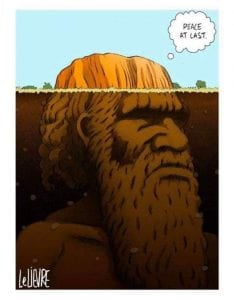
There are two issues I wanted to write about this week, one is the closing of Uluru Climb.

Creating thoughtful and active citizens through the awareness of social issues is part of what Arts education can and should do. Music has regularly played a part in contributing to social discussions such as the involvement in the Vietnam War, Nuclear Disarmament. Below are some ideas to engage with students in topical social and political matters as well as more technical aspects of music education.

There has been a lot of media exposure over the last couple of weeks about the importance to local Aboriginal people of the closure of the Uluru climb to the local Aboriginal people. A way of connecting this closure with Music is by allowing students to view and hear the re-release of the song ‘Solid Rock’ by Shane Howard. It includes special guests Dan SultanEmma Councillor-Donovan, Natalie Pa’apa’a (Rize), Archie RoachBart WilloughbyAmy Saunders, Myra Howard as well as the APY Lands Choir singing the Pitjantjatjara translation by Trevor Adamson and Ruby James.

Shane Howard hails from the legendary 80s band Goanna. I adored that band.  Their ‘Spirit of Place’ album was the first cassette I bought with my own money. That album included the original recording of the song ‘Solid Rock’.
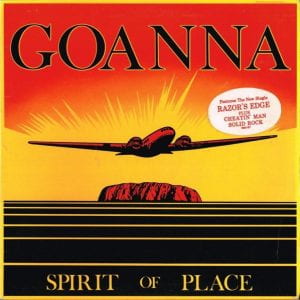
Shane posted on Facebook last week a re-release of ‘Solid Rock’ that was recorded in 2012 but never released.  Shane announced on Facebook that it seemed timely to share the song to co-incide with the closure of the climb.  In the post he says it gives respect back to the local Anangu people, the traditional owners of the land of Uluru. He titled the post Solid Rock (Puli Kunpungka) which is the Pitjantjatjara phrase for ‘strong now’.
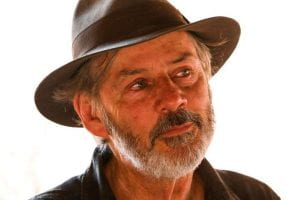
Here are the lyrics Shane published with the Facebook post last week.

SOLID ROCK, SACRED GROUND – Puli Kunpungka
© 1982 Shane Howard  Mushroom Music/Big Heart Music

Pitjantjatjara Translation: © 2012 Trevor Adamson/Ruby James/Shane Howard/Jodi Martin

Out here nothing changes
Not in a hurry anyway
You can feel the endlessness
With the coming of the light of day
Talking about a chosen place
They want to sell it in the marketplace
Just a minute now

Standin’ on solid rock
Standin’ on sacred ground
Livin’ on borrowed time
And the winds of change
Keep blowin’ down the line

’Round about the dawn of time
Dreaming all began
Proud people came
Livin’ in a promised land
Runnin’ from a heart of darkness
Searching for a heart of light
This could be paradise

CHORUS

Standin’ on the shore one day
Saw the white sails in the sun

Wasn’t long before you felt the sting
White man, white law, white gun
Don’t tell me that it’s justified
Cause somewhere, someone lied…..(Captain Cook lied)
It’s hard enough just to survive
Who’s that crying?
Genocide
But we’re getting stronger now, stronger now

Puli kunpungka ngaranyi
Manta miil-miilpa katu
Nyuntu kurangka ngaranyi
Walpa kampa kutjuparinyi
Walpa pulkaringanyi

Puli kunpungka ngaranyi
Manta miil-miilpa katu
Nyuntu wirungka ngaranyi
Walpa kampa kutjuparinyi
Walpa pulkaringanyi

Standin’ on solid rock
Standin’ on sacred ground
Livin’ on borrowed time
And the winds of change
Are blowin’ down the line

Re-reading these lyrics now, 30 years after it was a hit brings a new awareness.  How pertinent that message was then … just as it is now. Having visited Uluru myself I can appreciate the significance of this national landmark and how important this feature was to the local people to hold and retell the ancient stories, songs and dances. The issue of time, whether 30 years of music history, or tens of thousands of years for the local people …. Nothing changes …. Not in a hurry anyway.

Back to contemporary times Trevor Adamson and Shane Howard have also released another song about Uluru marking the climb closure called ‘Palya Wiru Uluru’.

Below is some information that Shane posted to mark the collaboration.

The GoannaFella and APY Elder united to write new chapter after Uluru climb closure.

“We came together with this song to give people the chance to hear the story of the rock from the Traditional Owners” says Trevor Adamson.

Howard added, “In the past we didn’t understand the deep spiritual connection of Anangu to Uluru. Climbing the rock was seen as a rite of passage for us whitefellas. Now we know better and it’s time to come together in a deeper understanding of country.”

“I want people to understand the country is really precious and really sacred. We want to look after it,” said Adamson. “It’s still a sacred site from the past”

A two track EP titled, ‘Palya Wiru Uluru’, will be launched to commemorate the close of the climb at Uluru. Uncle Trevor and Shane will perform the song together at the closing ceremony.

“I feel honoured to be asked to write and invited to perform the song with Uncle Trevor at the closure of the climb celebrations on Sunday. It feels like a full circle since writing ‘Solid Rock, Sacred Ground’, all those years ago” said Howard.

The EP is available to download or buy at:
https://shanehoward.com.au/palya-wiru-uluru
and at Maraku Arts at Uluru

The closure of the climb has been controversial in some circles.  This is probably due to the different backgrounds and cultures.  With regards to these differences, I say a decision has been made by the traditional owners.  It is a decision that they have been able to make as our First Nations peoples gradually find a voice.  Let us respect their decision and hear their voices.
Suggested Activities

Early Childhood Students to Year 3s

Students play un-tuned percussion instruments along with the released ‘Solid Rock – Puli Kunpungka’ .  Try different rhythmic patterns for the verses and the chorus.  An example could be for verses ta ta tete ta, for the chorus ta tete ta tete.   Then allow for discussion with topics like why are there so many different musicians involved?  What does it say about the importance of the song when there are so many musicians involved?  What is the mood of the song, music and musicians?  How important is Uluru in the song?  Describe the different musicians involved in the song. Play Palya-Wiru-Uluru song and compare the two songs –what is similar and what is different and the two pieces of music?

Years 4-12

Provide students the lyrics of the released ‘Solid Rock – Puli Kunpungka’ either on white board or electronically.  Encourage students to follow along as the video is played.  Play song again, have students sing along.  Open for discussion. Questions could include why are there so many different musicians involved?  What does it say about the importance of the song when there are so many musicians involved?  What is the mood of the song, music and musicians?  How important is Uluru in the song?  Describe the different musicians involved in the song. Play ‘Palya-Wiru-Uluru’ song and compare it with the released ‘Solid Rock’ –what is similar and what is different and the two pieces of music?

Instrumental Students

There is sheet music for ‘Solid Rock’ available which teachers can readily access and adapt to suit their students needs.

Vocal and Choral Students

There is an accapella arrangement of the original ‘Solid Rock’ by Andrew Emnet available through the online store Sheet Music Plus.It is SATB plus Tenor solo. This could be adapted to suit the needs of different needs of different choirs and ensembles.

Thanks – to the great work of my editor husband Craig.  His work in this regard, as well as his general support with the blog, is so appreciated.
 

Down To Earth

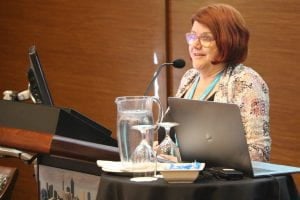
Robyn Veitch, the newly appointed President of the Australian Society of Music Education, Robyn Veitch, shared her most recent experience of embedding Aboriginal perspectives in her music program.

As Robyn shared the wonderful experience with me, it became clear how multifaceted the both the performance and its back-story was.  Robyn had just finished a performance with her choir from City Beach Primary School which opened the third phase of an Indigenous garden.

Pictured above – Robyn Veitch

This week I wanted to share Robyn’s example of embedding of Aboriginal perspectives. This example demonstrates how powerful, interesting and flexible the use of song and poetry can be. I also wanted to share some wonderful work by the great female vocal group Tiddas and how their work could be used in Music education settings.

Pictured above – Yamatji Artist Loretta Egan

Last month at the ASME National Conference Robyn won the raffle of a ukulele painted by Yamatji artist Loretta Egan.  The Yamatji people’s traditional country is the northern part of the midwest of Western Australia which includes the cities of Geraldton and Carnarvon.   After Robyn won the beautiful instrument she took it to show and share with two state primary schools in Perth’s northern suburbs where she teaches.  Robyn shared with her students information about Loretta’s painting.  Robyn also shared images of Loretta’s art from the website.  The students were really impressed with Loretta’s work. Robyn told me “they loved both the contemporary and the more traditional works”. This is a great example of teaching ‘in the moment’ and sharing an Aboriginal cultural perspective without pushing the point to its limits and having students lose interest.

Pictured above – Loretta’s Artistic Ukulele, and me, Jane Nicholas

As happens in our work as music teachers Robyn was asked to put together a musical performance for the opening on an indigenous garden at her City Beach school.


The garden had come about as there was an old and not visually pleasing area of the school that the school decided need to be re-purposed.  Stage 1 of the construction of the Indigenous Garden included consultation with local government council who provided advice from their Indigenous Officer and local elders.  This informed Stage 2 and Stage 3.  Stage 2 was the construction of a yarning circle. Stage 3 activities were the planting of a native food section of the garden.  The 3 stage project has taken a year to complete and has formed part of curriculum studies across the whole school. The principal has made quandong jam from the quondongs that come out in spring.  The children across the school have learned about food, the 6 Noongar seasons and lots of other aspects of indigenous culture and life in this area.


So…what about the music education component?


Here Robyn describes the process “Musically we needed a song for the opening so I taught the children the chorus of From Little things …..the song by Paul Kelly and Kev Carmody (a Murri man from northern Queensland) song from the 90’s.  We added poetry that talked about the journey the school has made in forming the new garden areas.  The Yarning circle in the native food/tucker garden is at the heart of the project”.

Pictured above – Robyn and City Beach PS opening Stage 3 of the school’s Indigenous garden

Robyn has generously shared the poems which were read while the ukes played a C chord during the performance.


City Beach Garden Song

Gather round people, let me tell you a story
About all the plants and the people here

We’ve made three new gardens full of life and joy

Under the gums and Quandong trees,

From little things big things grow


So many areas have been brought back to life

With vegetables and herbs, it a beautiful sight

Malak Merenyj Bidi grows bush tucker food

A yarning circle, its crown is its heart.


From little things big things grow


To complete the story, we are here today

Before us an edible garden created with care.

We’ll water it, nurture it, get rid of the weeds.

And we’ll watch it grow for us to share!


From little things big things grow


Robyn has also included two versions of the chord pattern for ‘From Little Things Big Things Grow’ which she taught some of her choir students to accompany their singing.

 Chords for Chorus

Simple:

C                        Am               G           C                       Am                G

From little things big things grow. From little things big things grow.


Trickier:

C        Am               Em         G              C    Am             Em             G

From little things big things grow. From little things big things grow

Pictured above – the opening of the City Beach PS Indigenous garden


The opening of the edible garden was the final part of the project.  The school staff, parents and other interested community members have converted an old and really ugly storage are into a kitchen garden that will be cared for and shared by the whole community.


Tiddas

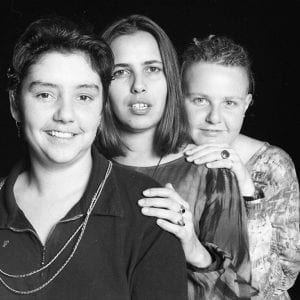
Originally the three women, Amy Saunders (a Gunditjmara woman from Portland), Lou Bennett (a Yorta Yorta Dja Dja Wurrung woman from Echuca) and Sally Dastey (from West Heidelberg) combined their vocal talents as backing singers for Aboriginal band Djaambi. The group were invited to perform at a musical celebration for women’s artistic achievement, ‘Hot Jam Cooking’, in Richmond, Victoria. Their performance was well received. It inspired the ground-breaking Ngarrindjeri singer songwriter Ruby Hunter to name the trio ‘Tiddas’, which is a Koori word (demonym for Aboriginal person from NSW or Victoria) meaning “sisters”.

Pictured above – Tiddas in 1990s

After performing together for over a year the band came to the attention of Paul Petran, host of ABC National Radio show ‘Music Deli’, who assisted Tiddas to record their 1991 debut EP, ‘Inside My Kitchen’.  Inside My Kitchen was released in October 1992 and received two nominations, for ‘Best New Talent’ and ‘Best Indigenous Release’, at the ARIA Music Awards of 1993.


They released an album in 1993 called ‘Sing About Life’ which achieved gold status.  It included the popular song ‘Inanay’ which is sung in Yorta Yorta language (there are differing views as to its origins). In 1996 the band released a self-titled album produced by Joe Camilleri.  Their last album was released in 1997 before the band wound up.  It had been one of the most successful First Nations acts of the 1990s.


In August 2019, Tiddas were inducted into the National Indigenous Music Awards Hall of Fame.

Pictured above – Tiddas 2018

Happy Earth – Tiddas

I love this last section of the song – here are the lyrics and chords. Its in triple time, Yay!!!!

Crystal blue lake makes for sturdy strong eucalypt

Makes laughing kookaburras sing to the sky

Clouds floating by on the air that we breathe

Rain falls on down to the rivers and seas

Happy earth, happy earth, happy earth, happy earth


Chords available     from Chordify

Suggested Activities

Early Childhood to Middle Primary

Teach students to sing selected section of Happy Earth.

Have students create own movement sequence to express the lyrics while teacher plays a simple repetitive drumming pattern.

Perform as follows

  1. Happy Earth Song section sung by all students
  2. Half students perform movement accompanied by drumming
  3. Happy Earth Song section sung by all students
  4. Half students perform movement accompanied by drumming
  5. Happy Earth Song section sung by all students


Upper Primary to Secondary

Teach students to perform A D and E chords on various instruments.

Have students research traditional bush foods from your local area.  An example for schools on Whadjuk Noongar country is the following information.

https://www.nacc.com.au/wp-content/uploads/2018/06/Sharing-Noongar-Knowledge-Part-4-Bush-Foods.pdf

In small groups students are to prepare and perform a poem accompanied with an A chord on different instruments.

Have students perform as follows:

  1. Happy Earth Song section sung and accompanied by all students
  2. Group 1 students perform poem and chordal accompaniment
  3. Happy Earth Song section sung and accompanied by all students
  4. Group 2 students perform poem and choral accompaniment
  5. Continue to work through poems and Happy Earth until all groups have performed their poems
  6. Happy Earth Song section sung by all students


Choral

The Canberra Acapella choir Cyrenes performs an arrangement of Happy Earth.  Have students listen to the piece.  Discuss which parts are the best by the choir and which elements could be improved. Have students provide suggestions for strategic improvement. Then play the song again and see if students can join in a particular part – you may allocate different sections for them to follow and or recreate.

http://www.cyrenes.org.au/ourcds


Music A Medicine For Aboriginal Black Dog

Music A Medicine For Aboriginal Black Dog

: Music Teachers Can Improve Aboriginal Mental Health

Last week was Mental Health Week.  This is an issue of great importance for Australian society generally.


Social and emotional health stresses for Aboriginal people are more problematical given the colonisation and government policies of the last 250 years.


This week’s blog discusses the challenges facing Aboriginal people in terms of their social and emotional well-being and how music can benefit.


It discusses the role Music teachers can play in promoting Aboriginal mental health, directly through teaching Aboriginal students It will also outline the indirect impact Music teachers can have by embedding Aboriginal perspectives in their teachings.  This will lessen the poor mental health that results from a person’s identity and existence being denied.


The book “Essential Aboriginal Insights” by Jolleen Hicks will be examined as an excellent guide to understanding cultural differences to inform strategies and plans.


Two contemporary songs will be offered as potential repertoire.  These have been chosen for the positive lyrics, current nature and catchy videos. Both songs promote Aboriginal voices and artistry which are important in highlighting Aboriginal identity and cultural pride. The songs are ‘Black Boy’ by Flewnt featuring Emily Wirramurra, and ‘Freedom’ by MauPower.


Social and Emotional Well Being Of Aboriginal Australia

The Australian Indigenous Health InfoNet website states :

“For Aboriginal and Torres Strait Islander people, a number of events in the past have had a serious ongoing impact on their social and emotional wellbeing. These include dispossession from their lands (loss of lands), and the impact of the policies and actions that followed, such as the forced removal of Aboriginal and Torres Strait Islander children from their families and homelands.”


Professor Helen Milroy, an Indigenous psychiatrist, describes three important themes to come from an analysis of Aboriginal and Torres Strait Islander history. They include: ‘the denial of humanity, the denial of existence and the denial of identity’.


Also of importance to the social and emotional wellbeing of Aboriginal and Torres Strait Islander peoples are the general disadvantages experienced by in the areas of education, employment, income, and their overall position in Australian society. These areas, which are some of the important ‘social determinants of health’, are linked with many other external stresses. Stresses include serious illnesses and disability, higher levels of death in the family/community, overcrowded houses, substance use problems, violence, discrimination and racism, trouble with police, and being sent to jail and/or having a family member who has been sent to jail.”

https://healthinfonet.ecu.edu.au/learn/health-topics/social-and-emotional-wellbeing/


These social and emotional health issues seem overwhelming.  The issues could appear so pervasive and serious that they seem beyond what a music teacher could ever influence.  Could there be something we can do?


Research tells us that music education positively impacts students’ abilities to learn, their educational outcomes and leads to improved social outcomes.  We may not be able to fix all the problems but if we teach students with Aboriginal ancestry we can improve their educational outcomes and other life skills by ensuring we deliver fantastic music education programs.


Quality music programs should also embed Aboriginal perspectives.  This will ensure that social short-comings identified by Professor Milroys’s studies of the denial of humanity, existence and identity will be lessened for our students and our society’s future.


We can make a difference.  It may be like the Turkish story where just one starfish thrown back into the water from the sandy beach doesn’t appear to have made much of a difference.  The story notes to that one starfish, the effort a big difference.  The power of one.  We must also remember the power of many.  Together we can make a huge difference.


Essential Aboriginal Insights

One resource that I came across this week is ‘Essential Aboriginal Insights’.  It is a book I bought online from Jolleen Hicks.  Jolleen is a Ngarluma- Aboriginal woman born in Wickham and grew up in Roebourne in the Pilbara region of WA. She graduated with a Bachelor of Law from the University of WA in 2006 and received her legal practising certificate in 2008. She has worked for Rio Tinto and Native Title services before establishing herself as a consultant where she aims to change mindsets and build the understandings and respect between both Aboriginal and non-Aboriginal people. Her work and the resulting book are responses to the unfortunate failure of continuous services and programs to “Close the Gap” for Aboriginal communities.

Jolleen’s book clearly lays out strategies for achieving closer links with Aboriginal people and communities.

Pictured above – Jolleen Hicks

These close links are what education departments tell us we need to be doing.  Music teachers want to do it.  This book provides the how.  It tells us that positive relationships are not built in a ten minute coffee and chat session.  It tells of the need to be patient and stages to work through.  This is not a book directed at Music teachers, but we should be part of the ‘closing the gap’ team and therefore we, together with our non-Music colleagues, should be reading this and taking Jolleen’s messages on board.  Her stories are very rural based.  She clearly outlines how we need to understand there are great variations between Aboriginal communities and a positive relationship with one community will not immediately or necessarily transfer to another community.  The process will be long term. Issues for relationships with Aboriginal people in cities will be similar, but there will be differences.  Her strategies are clear and respectful, transference to the city and suburban contexts should be seamless.


The book would be a great asset for every school and for all teachers involved in formal education, including Music teachers.  Embedding Aboriginal perspectives across the curriculum is mandatory across the country.  Respectful community consultation is needed for it to be effective.  This book outlines how to consult.

It is available online.  It is not a long read, but there is gold in every chapter. One example is in the first chapter of the book.  Here Jolleen discusses all Australians to be wary of assumptions we may have and the stereotypes that feed into the assumptions.  These she says can “cause barriers that prevent you….building relationships” p13.  Another example is in Chapter Two. Here she suggests to research the Aboriginal community with which you want to engage before starting face to face meetings.  Here she suggests we take the time to learn about the history so you can appreciate the barriers and challenges that exist for Aboriginal families from that specific community”. I urge all schools to purchase it and for all teachers to read.  It is perfect for those schools and school boards looking to draft and implement a RAP (Reconciliation Action Plan) which, pleasingly, many schools are pursuing.


Jolleen’s hope is that “every Australian has a copy of this book so that every Australian is empowered with the minimum learning required to positively impact the spaces of Reconciliation and Closing Gaps”.


She says that “collectively, we have a responsibility that we are failing to deliver on. We are failing to eliminate racism from our country; dismantle the racist structures, systems, processes, institutions, and discrimination that still here today; and we are failing to preserve Australian Cultures and Heritage”.


She wants the book to be a way to empower Australians with the confidence to walk together respectfully and successfully.


Artist Mau Power

Mau Power was born Patrick James Mau. He is a hip hop artist from Thursday Island in the Torres Strait and is the first Australian rapper to tour from this region. He is also the founder and executive director of One Blood Hidden Image, the first Torres Strait independent record distribution label, film production and media company.

Pictured above – Mau Power

His story adds a deeper layer of meaning when listening to his music. It contextualises the lyrics and passion.


Patrick is a Dhoebaw man of the Guda Malullgal nations and is guided by two cultures – Indigenous and hip hop.


He was incarcerated in 2001 for nine months for a street fight and said this jail time made him reflect on his life, and he decided to focus on his music, which he said is dedicated to inspiring others.


He is now a strong community leader and works with young people throughout the Torres Strait Islands and Australia.


He is the father of three girls and lives on Thursday Island.


Song – Freedom

Freedom is a fantastic collaboration between Mau Power and senior and respected Aboriginal songman Archie Roach. The combination of these very different artists brings together the young and the old, Torres Strait Islanders and mainland Aboriginal cultures, pain and triumph, despair and hope, folk and hip hop.

The variation between the hip hop and lyrical sections are interesting and easily identifiable for students for all ages.  The use of Indigenous language chants as well as orchestral accompaniment brings together traditional Australian and western artistic elements.

Pictured above – Archie Roach

The lyrics by MauPower are important in terms of revealing and accepting some disturbing historical past truths.  It is important for Aboriginal people in determining their emotional and social well being that the wider community accepts these historical truths.

Mau Power uses language that is acceptable for the school context.

https://www.youtube.com/watch?v=xMqG_LyD9s4

Artist – Flewnt MC

Flewnt is a Noongar artist and was born Josh Eggington. Flewnt recently shone at the Western Australian Music Industry Awards 2019.   He picked up three awards. He won the Outstanding Indigenous and Urban/Hip Hop categories. Also a song he collaborated with Vanessa Hopes achieved the Grand Prize Runner-Up. The song Kya Kyana translates as “welcome to the ceremonial ground” in Noongar.

Pictured above – Flewnt

Song – Black Boy

Black Boy was originally written and recorded by Coloured Stone, a band from South Australia, west of Ceduna.  The song became a hit on its release in 1984. Coloured Stone is led by Mirning Elder Bauna Lawrie.

Pictured above – Coloured Stone

Emily Wurramurra paid tribute to the Coloured Stone song ‘Black Boy’ by recording her own version and releasing it in 2017.

Pictured above – Emily Wurramurra

Flewnt has since collaborated with Emily to produce his re-invention of the song this year.   The structure is very similar to that of MauPower’s Freedom with a lyrical chorus by Emily Wurramurra.  His lyrics, like MauPower’s ‘Freedom’, are very much about truth telling.  He like MauPower calls on young people to be strong and strive for better futures. The hope in the lyrics where he gently addresses the young with messages of support is so important for our young Aboriginal people to hear.  All students would benefit from connecting with his lyrics.

https://www.youtube.com/watch?v=6qb2darwLbI


Suggested Activities

Early Childhood To Middle Primary

Provide scarves or ribbons for students to move with.  Play the video clip of either Freedom or Black Boy available on Youtube and students can move ‘off the spot’ in the hip hop sections and ‘on the spot’ for the ‘singing parts’. I would use one of the songs three or four times in one week. A couple of weeks later I would introduce the second song and use that a couple of times.  Allow for discussion time after the movement to music session.  Once both songs have been explored allow for comparison.

Upper Primary to Secondary

Teach and sing the chorus for either song.  Play the video clip of either Freedom or Black Boy available on Youtube and students to join in the singing of the chorus.  Have students reflection on the lyrics and the issues facing young people and possible solutions the song provides.

After listening to the song a few times have students complete an aural dictation exercise where they are required to ‘play the melody by ear’.  Students could work on an instrument of their choice and in small groups.

Have students notate the pitch and melody in standard or graphic nottion.

Repeat process for other song.

Compare and contrast the pieces.

What To Do With A Didgeridoo? Didgeridoo or Didgeridoo…n’t?

As Music teachers what can we do with this instrument.  Can we play it?  Can we have our students play it?  Can we teach it?

It is an area around which there is controversy.  It is an area where we as Music teachers could come under criticism.  There are differing views.

Pictured above is Noongar Elder, Didgeridoo musician Dr Richard Walley.

My understandings and practices are as follows:

Would I play the didgeridoo?  I understand there are women who are allowed an encouraged to play the instrument in the Northern Territory where the instrument was reportedly invented.   In the past I have sought instruction to play the didgeridoo in order to make the instrument available to my students with the idea of a didgeridoo orchestra at my school.  I now consider the instrument belongs to the Aboriginal peoples and is an instrument for them which holds sacred meaning. I still like the idea of the Didgeridoo orchestra, but this is not an idea I feel is appropriate for me to pursue as a white woman, or if I was a white man. If I was invited by a senior Aboriginal elder, I may change my mind.

Can Our Students Play It?  Well they do already every time we hand out the Boomwackers, no matter how many times it is reinforced not to put their mouths on the ends.  Yuk.  But beyond this is it ok? I believe if students are exploring independently and creatively playing this is great. They are connecting with Aboriginal culture musically.  In this instance I would discuss with the whole class some protocols of using the instrument i.e. not women, should be introduced to the instrument by an Aboriginal elder and played as the elder directs.

Pictured above is Didgeridoo musician Mark Aitkins.

Can Our Students Perform It? I would have students perform on a Didgeridoo it if they had been introduced to the instrument by an Aboriginal elder.  I would inform and invite local Aboriginal community members to attend as special guests.

Can We Teach It? I would say no unless you are an Aboriginal elder or Aboriginal musician.

Pictured above is Aboriginal musician William Barton.

Can It Be Part Of A Music Teaching Experience in the Contemporary Australian Classroom? Absolutely it should.

The inspiration for this post is an article I was alerted on facebook.  I have attached the link for the article here.  I would like every Music teacher in Australia to read it.  It is fabulous. It is called “The Remarkable Yidaki : And No Its Not A Didge” and was written a little over eighteen months ago by Christine Judith Nicholls, a Senior Lecturer in Australian Studies from Flinders University.


Another inspiration for this post was the teaching of didgeridoo to non Aboriginal musicians and music teachers at a recent workshop held in Perth.  In my journey to better understand Aboriginal music and culture and find places for it in Music Education, this is not something I think is appropriate.

https://theconversation.com/friday-essay-the-remarkable-yidaki-and-no-its-not-a-didge-74169?fbclid=IwAR2MAEc4aPl8CJ12veaC4VC5xF4U7D69wmrk6JFkdXCj8pZDtmBGX73G-kg

Pictured above is respected Aboriginal musician Matthew Doyle – his spellbinding playing features in ‘Dawn Mantras’ by Ross Edwards.

Classroom Ideas

Ten ideas for using the Yirdaki or Didgeridoo in a musical education context with a non-Indigenous educator.

  1. Invite a musician of Australian First Nations heritage to perform for your students live.
  2. Watch a youtube clip on the construction of a didgeridoo such as  https://www.youtube.com/watch?v=yb6fxCrSohw
  3. Listen to a recording of a piece of music which includes the yirdaki such as ‘Dawn Mantras’ by Ross Edwards. Have the students move to the music.
  4. While listening to a piece of music that includes the didgeridoo ask students to notate the didgeridoo line.
  5. Have students explore the musical elements of the piece of music that includes didgeridoo.
  6. After listening to a piece that includes the didgeridoo, invite students to play the musical line of the didgeridoo on different instruments.
  7. Listen to the didgeridoo line from a piece of music and use it as a stimulus for the exploration of bass instruments and their role in musical ensembles or in traditional music generally.
  8. Have students discuss the intersection of visual art, dance, music, stories and ceremony in a performance that includes the didgeridoo. The following clip could be viewed as stimulus to discussion. https://www.youtube.com/watch?v=_b-vI3Nf50g
  9. After listening to a piece that includes the didgeridoo invite students to discuss how an instrument and musician can be a storyteller.
  10. Have students explore the place of a didgeridoo in terms of instrument classifications. Is it brass, woodwind or percussion?

Pictured above is the Didgeridoo musican David Hudson.

My top five ‘Didgeridoo’ players

David Hudson – from north east coast of Australia from Ewamin (pronounced Oo-rah-min)/Western Yalangi, known as the ‘cultural journeyman of Australia’. Involved in folk, rock and new age music.

William Barton – born in Mount Isa, Queensland, a Kalkadunga man. Strong links to classical music.

Matthew Doyle – Didgeridoo player, singer, composer, dancer, choreographer and teacher.  He is descendant of the Muruwari Aboriginal nation from northwest NSW and is also of Irish heritage. Performs a lot of large scale traditional music and dance both live and for TV and film.

Mark Atkins – born in Albany but descends from Yamatji people of Western Australia. Part of contemporary music scene.

Djalu Gurruwiwi – custodian of the Yidakki ,from Yolngu people, a senior member of the Galpu clan from islands off Northern Territory. He was the crafter of first didgeridoos for the ‘Yothu Yindi’ band established by Dr M Yunipingu. A ‘Djalu’ didjeridoo is considered the finest crafted yidaki instruments.

Special Note I have only included First Nations peoples of Australia.  It is an instrument created by Aboriginal peoples and is considered by many Aboriginal people to be an instrument of their culture.  Given the levels of loss by Aboriginal people in two hundred and fifty years I am not comfortable with non-Indigenous peoples playing the instrument unless specific permission has been given and this permission is publically shared and widely held by Australian Indigenous people. Other people’s view may differ from me. 

My favourite pieces

Dawn Mantras composed by Ross Edwards with Didgeridoo solos by Matthew Doyle

Concerto For Didgeridoo Part III Water composed by Sean O’Boyle and performed by Queensland Orchestra and William Barton. From the ‘O’Boyle Riversymphony’ album. Available from Itunes. I am a bit of a collaboration addict.

“Outback” by David Hudson from ‘Heart Of Australia’ album by David Husdon and friends. Available Itunes

Pictured above is the didgeridoo bone – a slide didgeridoo – really interesting.


References:


“Didgeridoo Players You Should Known (Top Ten) by Al Block October 28 2015 as published on Didjproject.com

Davidhudson.com

https://en.wikipedia.org/wiki/David_Hudson_(musician)

https://en.wikipedia.org/wiki/Djalu_Gurruwiwi

https://www.qso.com.au/musicians/orchestra/william-barton


https://en.wikipedia.org/wiki/William_Barton

Finding Solid Ground : Industry Collaboration and Mentoring Aboriginal and Torres Strait Islander Students in Secondary Schools

The Australian Society For Music Education’s XXII National Conference opens tonight. I have been on the convening committee led by Robyn Veitch and after more than twelve months of planning it’s almost showtime!!  The committee and myself are hopeful that many Music educators will be inspired by the range of workshops and papers being presented, and from my personal perspective, especially the Indigenous perspectives strand running through the program.


The workshop I most want to participate in on Wednesday is being presented by Thomas Fienberg and Debbie Higgison.


This blog gives some introductory information about the workshop, some information about the music teacher and the Arts administrator behind the workshop and some activities inspired by Thomas Fienberg’s work in embedding Indigenous perspectives in music education.


The workshop will document and evaluate the benefits of inviting professional Aboriginal and Torres Strait Islander musicians into secondary schools to help mentor Aboriginal and Torres Strait Islander students and inspire the broader school community.


The workshop will draw specifically on relationships formed between a group of school students in the diverse community of Blacktown in Western Sydney and award-winning singer-songwriters Thelma Plum (Gamilaraay) and Emma Donovan (Gumbaynggirr and Naminjee).  Very cool.

Thelma Plum pictured above

Importantly, the artists will join the conversation live via video link (or if technology fails video messages have been pre-prepared). Participants attending the workshop will also get the opportunity to learn songs by Thelma and Emma, which will be shared directly with the artists. WOW!!!

Emma Donovan pictured above

This workshop ultimately endeavours to illustrate the benefits of educators working collaboratively with arts-organisations. When the team works together, they can provide students with real-world experiences that schools alone can’t provide. At Thomas’s school the professional mentors have been able to build relationships, inspire creative expression and illuminate opportunities for future Aboriginal and Torres Strait Islander and non-Indigenous artists alike.


Who Is Thomas Fienberg?

For many years I have been following Thomas’ ground-breaking and important work in developing relationships between his school, his students and Aboriginal community members and musicians. He currently works in a dual context. He works in a High School in Blacktown in the western suburbs of Sydney and he contributes to the delivery of courses at the Conservatorium of Music at the University of Sydney. He has recently completed his PhD in Music Education where his research has focused on community driven, collaborative approaches to teaching and learning (through and from) Aboriginal and Torres Strait Islander Music. Thomas will be also presenting a summative reflection on his PhD experience on the first day of the conference. In 2017 he was the recipient of the ASME NSW Chapter, Barbara Mettam Award for Excellence in Music Education.


Who Is Debbie Higgison?

Debbie works as an Education Project Officer for the Solid Ground Program, an Initiative between Carriageworks and Blacktown Arts. Debbie is particularly skilled in community networking, engaging both Aboriginal and non-Aboriginal generations with respect to Aboriginal culture and community. She is a qualified social worker/community worker and behavioural therapist with qualifications from Sydney University, Blacktown and Mt Druitt TAFE. Debbie was named Chifley Woman of the Year in 2014 and NSW Community Hero Women of the Year in 2017. Debbie found out about her Aboriginal background as a teenager and has been on a journey to bring together the stories of the pieces she was given by different family members. Tracing her family back to the early 1800s to her Great, Great, Great Grandmother who was a Wangal Woman of what is now known as the Homebush Bay Strathfield area in Sydney NSW, part of the Dharug Nation. Finding pathways and connecting to culture through artistic outlets is what drives Debbie to work with youth and their families, who like her were only told small bits of their family due to disconnection and loss due to the stolen generations. She is a well-known and appreciated community leader across Western Sydney.

Debbie Higgison pictured above.

I recently asked Thomas to reflect on a couple of questions.  Here are his responses. I find it fascinating to hear about other music teachers and how they pursue their work.

Great to catch up again Thomas.  So could you share with us your favourite pieces of music?

This is constantly changing. I’m loving playing music from Benny Walker at the moment. A consistent winner is ‘Don’t Cut Me Down’ from ‘Into the Forest’. His new stuff is equally as good. It’s hard to go past songs with personal connections, so with that in mind, I have to choose a song from Thelma Plum and Emma Donovan. Thelma’s new album manages to balance the personal/political with great finesse. Personally I adore ‘Do You Ever Get So Sad You Can’t Breathe’ for its simplicity. ‘Black Woman’ by Emma Donovan and the Putbacks is a powerful track that has gone to another level for me following a recent collaboration.


Could you share a little about how you have been working with Emma Donovan in your school?

Emma Donovan is currently completing a residency at my High School in Blacktown, NSW through the Solid Ground program (see ASME Day 1). As part of the program we developed a dance/music performance of the Black Woman choreographed by NAISDA graduate Neville Williams Boney. We’ve performed it several times now at local NAIDOC events. It’s been great watching Emma be more confident in sharing her own music and seeing her surprise at the impact it has on the people involved in performing it.


What would be some favourite simple activities that you use when working with your students with particular pieces of music?

I like to keep things simple by just performing songs and allowing the music to speak for itself. I find that this allows students to develop an intimacy with the artist without the feeling of “being taught”. Conversations emerge in time and are contextualised through their personal association with the songs.


Beyond this, making contact with Aboriginal and Torres Strait Islander Musicians is hugely important. I’ve been fortunate to slowly build connections with several musicians over the years. Some artists are better at making contact – Alice Skye for example is super appreciative of contact from students. Building relationships and learning from local musicians is even more crucial and could be the starting point of a great idea or collaboration.


One more question please.  What performances have you experienced that you would describe as ‘the best’?

I’ll take this not so much as a song to perform, but as a performance to view and learn from… If in Sydney, Yabun on Invasion/Survival Day is a ritual well worth observing. In the NT, the NIMAs are great for sourcing new artists. Elsewhere local community events are a must to start building trust and understanding in your community. I haven’t been, but am dying to catch the Boomerang Festival linked with Bluesfest (although I think we need to be pushing for a greater mainstage presence for Aboriginal and Torres Strait Islander artists as opposed to placing them on sideshows at festivals).


Six Ideas For Music Educators To Do Better With Embedding Aboriginal Perspectives

(as inspired by Thomas Fienberg and Debbie Higgison)

  1. Attend local NAIDOC events.
  2. Attend local festivals especially those with an Aboriginal or Torres Strait Island cultural focus.
  3. Make contact with your local Aboriginal community to build relationships and investigate what ideas they have for music education and embedding culture.
  4. Listen to music by Aboriginal popular musicians. Is there a local musician who might share their music and music making at your school?
  5. What different ways could their songs and pieces be used in the classroom?
  6. Find out about some local Arts organisations in your area. Ponder a collaboration with them.


I hope many of you will be able to attend the workshop.  I will provide a review for those of you that are not able to participate. In the meantime check out some of Emma Donovan’s and Thelma Plum’s music.  Keep your ears and heart open to new sounds, ideas and wonderful music.