The First Strings Orchestra In Australia – Aboriginal and Lepers

Post 3 January 15 2018

The Original First Nations String Orchestra 

A great part of our job as music teachers is the opportunity to meet a diverse range of people and to hear many different stories.  Here is a story about meeting Helen Tuckey and learning about a nun treating leprosy in Derby in the 1940s to 1980s who used music to heal. How does this relate to embedding Indigenous cultures and perspectives?  Read on.


Helen Tuckey : Australian Strings Association National President

I was lucky enough to be at a workshop she delivered at ASME WA Summer School in January 2018.  We chatted afterwards and agreed to meet and talk some more.  This we did a couple of months later when she generously shared stories and resources.

Helen has so much experience and knowledge in working with different Aboriginal peoples, particularly in the Kimberley, where she was a visiting musician where she provided educational experiences for school children.  She also supported Aboriginal students to acquire high school scholarships to study string instruments in Perth.  Combine all of this, together with being a mum and professional musician with Western Australian Symphony Orchestra and she has a pretty full on time.

She has many amazing stories. She is a woman who doesn’t just talk, she thinks and acts.  She makes a difference by getting out and trying new and different things and by making considered new connections.  I hope you all get the opportunity to meet her one day.

For me the stand out story she related was from Bungarun, the leprosarium at Derby.  She told me of the first Australian string orchestra was actually in Derby, made up of Aboriginal lepers.


Background To The Orchestra

The leprosarium, established in 1936, saw the arrival of a new sister In the mid 1940s. She was both a registered nurse and a trained musician. Her name was Sr Alphonsus Daly and she replaced Sr Gertrude as sister in charge.

Sr Alphonsus began teaching the patients music and established a patient orchestra. She realised both adult and young patients could pick up how to play the instruments without the need to read music, and she appealed to the public and the government for donations of musical instruments. Oh how the world turns in similar circles through time, with a similar appeal currently associated with the “Please Don’t Stop The Music” campaign.

The patients played classical music and folk songs, and, in later years, jazz and “The Beatles”.

When official visitors came, they held concerts and dressed up, as you can see in this photo.  For Sr Alphonsus, the orchestra performed a number of different therapeutic functions; it was, in her view, a kind of panacea.

For her, playing music also helped to keep the patients distracted from their problems. And patients looking back on this time agreed this was the main reason they were encouraged to play. In their words ”music was an escape from confinement” and another claimed “it was to keep us occupied instead of thinking about our relations”. Another, that “it helped lift spirits up”.  In her memoirs, Sister Alphonsus called it the ‘therapy of distraction’.

This amazing woman demonstrated the power of music to heal bodies and hearts and how music brings people together.  The trust, cognitive and musical abilities of the Aboriginal people incarcerated at the leprosarium showed people can create beauty in the most unlikely of environments.


So What Can Music Teachers Do With This Story?

Inspire instrumental students

A way the Bungarun Orchestra  can be honoured is to remember this story and tell it to our students about the role music can play in our lives.


Create An Australian Context To “Big” Western Art Compositions

When we introduce pieces by Beethoven, Mozart, Wagner or Handel, we can tell this story and show them photographs or the video.


Explain how the orchestra was set up in a place where people were taken if they had a disease to be treated and were kept removed from the rest of society.  Over 1500 Aboriginal people were treated at this place in its fifty years of operation until 1986 a cure for leprosy was found. The leprosarium was closed.


High School Teacher Here Is A Relief Lesson

Here is a great opportunity for when your relief teacher is not music trained and but you want to keep the lesson related to music. The documentary presents memories of the leprosarium from former musicians of the orchestra. It illustrates the positive impact classical music and music generally can have on people’s lives. It also shows how music can build bridges between different peoples in society.


Post Script

Sister Alphonsus Daly after her retirement lived on at the leprosarium . She died at St John Of God Hospital, Subiaco, Perth on August 8 1980 and is buried at the Karrakatta Cemetary.


Post Post Script

Just last month, December 2018 the Broome Advertiser announced the proposed creation of a memorial garden at the Derby leprosarium was announced.  It is to be at the Sisters of St John Of God Heritage Centre in Broome.

“The Bungarun Reflection Courtyard will include a quite outdoor area, an audio station, interpretive signs and bend seats, telling the story of community spirit that arose.”

“Sister at the heritage centre also hope to incorporate the sound of a 50 piece orchestra started in 1944 by Alphonsus Daly, a nurse and musician who spent 36 years at Bungarun.”

Broome Advertiser 6/12/18


References:

https://heritage.ssjg.org.au/assets/historical-articles/academic/rahs-lecture.pdf

https://www.abc.net.au/news/2016-06-26/former-derby-leprosarium-residents-hope-to-restore-site/7541626

“Healing Hands –Sister M. Alphonsus Daly, MBE of the Kimberley Mission : Memories and Milestones for the Derby Leprosarium.  Health Department Booklet produced to mark the 50th anniversary of the leprosarium.

https://www.abccommercial.com/librarysales/program/message-stick-healing-sounds-bungarum-orchestra

https://heritage.ssjg.org.au/assets/education/reep-tr-and-sb/year-6-missionaries-and-medicine—student-booklet-with-isbn.pdf

Memorial Garden Article Broome Advertiser, December 6 2018.


Many thanks to Helen Tuckey in her sharing of the stories and reference materials. Also her patience. JN

Happy Birthday Uncle Archie – Music Elements, Part Singing and Tempo

Dear Educators,

Archie Roach turns 63 this week – January 8. Best wishes to him from us.

He is a legend of the Australian music community. Archie Roach, born in rural Victoria, near Shepparton.

At four, with the removal of Aboriginal children being the policy of the day, Archie became one of the stolen generations.  First he was placed in an orphanage and then in different foster homes.

After a troubled time in his late teens and early twenties where he lived on the streets and battled alcoholism, he met his future wife, Ruby Hunter, at a Salvation Army drop in centre.  Ruby and Archie formed a band in the late 1980s called the “Altogethers”. He has been a prominent part of the Australian music scene ever since.

In these late 1980s he wrote a song that was to make the general Australian public aware of the stolen generations.  It was a very personal telling of the impact resulting from the removal of Aboriginal children from both their families and traditional lands. This song was “Took The Children Away”.  The song, and his first solo album, “Charcoal Lane”, was produced by Paul Kelly (yes, the Paul Kelly).   The album was celebrated at the ARIA awards after its release where it was certified ‘Gold’ and awarded two ARIAs at the 1991 ceremony. Archie was presented with a Human Rights Achievement Award for the song. It was the first time the award had been presented to a songwriter.

The song “Took The Children Away” has been one of the most important in Australian history. If you have not seen the video clip, I urge you to watch it – yes it’s on youtube.

https://www.youtube.com/watch?v=aywDT6yHMmo

It is so powerful. Make sure you watch to the end.  To hear him sing the song live is such a treat.

Archie has recorded more than ten albums over the past thirty years.  The past ten years have been testing for Archie with health and personal issues. In 2010 his beloved Ruby passed away and months later he suffered a stroke. The following year he was diagnosed with lung cancer.  Despite these life changing events Archie has continued to record and tour.  I am grateful for the opportunity to experience his words, music and passion, both recorded.

Using Archie’s music as inspiration I have created some music education activities which use three fabulous pieces.  Two are by Archie Roach.  The first is his anthem ”Took The Children Away”.

The second, more recent song, is called “Song To Sing”. Recorded in 2013, on the album “Into The Bloodstream”, it is one of my most favourite songs.  I love the message which tells the positive role music can play in relieving some of the symptoms of depression and mental illness.  For me the song is good medicine.

The third song used is a modrn reworking of Archie’s “Took The Children Away” by rapper, record label owner, actor and writer Adam Briggs.  Briggs was also born in the Shepparton area in Victoria.  He reworked the song in 2014 into “The Children Came Back” for the Triple J event “Like A Version”.

https://www.youtube.com/watch?v=3-wMbFntrTo

Given Australian society has moved on so much in the last twenty five years since the original song was written, this reworking is a fascinating encapsulation of Archie’s original song. It addresses contemporary issues facing our Aboriginal peoples and portrays their increasing empowerment, recognition and respect. The reprise by Briggs features significant Indigenous achievers from a range of eras, mostly from the Yorta Yorta nations of the Shepparton region.

“The song is a fusion of different Indigenous cultures and traditions. It includes Indigenous Tasmanian artist Dewayne Everett Smith as a vocalist and Gurrumul on guitar from the Gumatj clan on Elcho Island. Similarly the song includes a number of traditional musical elements such as clapping sticks, a yidaki from North East Arnhem Land, and a chant from the B2M (a group of musicians from the Tiwi Islands). Yet the song also fuses these traditional elements with contemporary hip hop culture.”  from Songs Of The Stolen Generations 

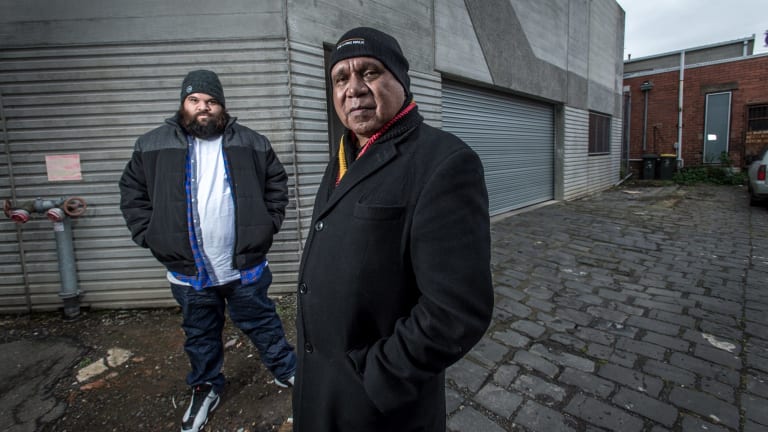
 Image result for roach and briggs

I urge you to listen to all three songs and perhaps try one of the activities below.


Students Understanding Tempo and Dynamics Impacts Music Mood can be explored using “Song To Sing”. I think this is my favourite “Archie” song. This activity is suitable for students from Year 1 to 4.

1.       Have students move to ”Song To Sing” from “Into The Bloodstream” album.

2.       Discuss with students the change in dynamics and tempo in the chorus.

3.       Have students sing or play other pieces changing tempo and/or dynamics and have them verbalise the change in mood each time.


Developing Part Singing Skills using the song inspired by the Stolen Generations anthem “Took The Children Away. It would suit students in years 3-7. The reworking of the song by Indigenous rapper and writer Adam Briggs is still incredibly powerful, but much more hopeful in an Australian society which is much more aware of the terrible impacts of the Stolen Generations policies.

1.       Sing the original song to your students from “Charcoal Lane” album.

2.       Show youtube clip of Briggs’ reworking of the song “The Children Came Back”. https://www.youtube.com/watch?v=3-wMbFntrTo

3.       Teach students the ‘oo’ ostinato and have them sing this along with the Briggs recording.

Compare and Contrast Elements of Music for students from Year 7-10.

1.        Students listen to both “Took The Children Away” by Archie Roach and “The Children Came Back” by Briggs.

2.       In pairs compare and contrast the elements of music of the pieces.


Protocols: 

  1. Acknowledge Archie Roach as the songwriter of “Took The Children Away” and “Song To Sing”. Acknowledge he was born in Mooroopna in 1955, near Warrnambool. He is one of the Stolen Generations, taken as a child from his mother, Nellie, a Gunditjmara woman, and father, Archie, a Bundjalung man from New South Wales.
  2. Acknowledge Adam Brigss is an Indigenous Australian from the Yorta Yorta people. He grew up in Shepparton, central Victoria. He re-worked Archie Roach’s song “Took The Children Away”.


References:   

https://en.wikipedia.org/wiki/Archie_Roach

https://songsofthestolengenerations.weebly.com/adam-briggs-the-children-came-back.html

https://creativerep.com.au/artists/adam-briggs/

https://www.vic.gov.au/aboriginalvictoria/community-engagement/leadership-programs/aboriginal-honour-roll/2011-victorian-aboriginal-honour-roll/archie-roach.html

A New Year – A New Beginning – Dawn Mantras

Dear Educators

Welcome to this new blog.

Firstly, I would like to pay my continued respect to all the Elders, past, present and emerging on our beautiful lands.

This blog aims to provide regular inspiration for Music teachers on ways to embed Indigenous Australian cultures into our learning programs.

We will be exploring musical education with a different slant, rather than using traditional Western Art music sources, Indigenous references will be made.  There are protocols to observe when using different sources or ideas from Indigenous cultures.  Ways to honour the ancient cultures will be presented.   I hope some of the ideas will find their way into classrooms and thereby improve teachers, students and the broader community’s cultural understandings.

To start the new year I think a collaboration of Indigenous and Non Indigenous cultures is a great way to begin. ‘Dawn Mantras’ is a wonderful piece of music by Ross Edwards, with a wonderful didgeridoo solo and accompaniment by Matthew Doyle.

Ross Edwards composed ‘Dawn Mantras’ especially for the Dawn Performance  telecast to the world from the dawn of the new millennium from the Sydney Opera House. This work expresses hope for peace and renewal. It was a wonderful collaboration with Aboriginal dancers, singers and musicians, and featured Matthew Doyle on Didgeridoo. It does not reference any particular cultural region.

Ross Edwards, born 1943, is a non-Indigenous Australian composer of a wide variety of music including orchestra, choral and film music.  His distinctive sounds in his music reflect his deep interest in ecology and his belief in the need to reconnect music with elemental forces and dance. He recognises music as an agent of healing.

Matthew Doyle is a professional musician (Didgeridoo player, singer, and composer) dancer, choreographer and teacher.  He is descendant of the Muruwari Aboriginal nation from northwest NSW and is also of Irish heritage.

The piece can be readily purchased from Itunes.

Protocols: Acknowledge the piece was composed by Ross Edwards, and utilised the skills and cultural understandings of musician Matthew Doyle, a descendant of the Muruwari nations from the northwest of NSW.  

For secondary students the piece could be used as a graphic notation activity where students draw different musical ‘voices’ as they hear them, noting pitch, dynamics and rhythms.

Primary and early childhood groups try the following movement activity.

Firstly the teacher assigns students to be different bush characters, sun, stars, fire, children and people.  Students could be provided scarves of various colours. Teacher to outline the events of the activity (as below). Students take their positions around the room (a clear space is great) and start the music with teacher providing verbal ‘narration’ to prompt changes.

Timeline of Piece and Suggested Movement
0-2.55mins Children and animals have been asleep under the stars. Sun and creatures start to rise out of the earth very slowly, little by little.
2.55-3.35mins Animals and children move swiftly walking not touching or looking at each other around in different pathways around the fire.
3.35 – 5.08mins On the spot moving as per their character, slowly stretching tall and wide

5.08 – 6.15mins swiftly moving as previous
6.15mins – end Walking around shake hands with different new friends. A better world is made.

If you have any ideas for embedding Indigenous Cultures please message me. I would love to make this as vibrant a community as possible with many voices.

Yours in Music

Jane Nicholas

ASME WA Committee Member

References:

Dawn Mantras (1999)

https://en.wikipedia.org/wiki/Ross_Edwards_(composer)

http://www.prideaux-e.com/australiana/matthew_doyle.htm